Success and failure (and the importance of both)

“When you take risks, you learn that there will be times when you succeed, and there will be times when you fail, and both are equally important.” –Ellen DeGeneres

Sometimes we fail. Sometimes we succeed. But what I’ve found is that I learn just as much, if not more, from failures as I do from successes. Each outcome that we encounter in life can teach us something – we just have to have to look for it.

Having “good” or “bad” days is all relative. You can’t have one without the other. It’s hard to appreciate the good days without the bad, because eventually we begin to take it for granted. How often do you think of how you’re feeling physically? Probably not very often if you aren’t in pain or sick. But when you are sick, you realize how good you had it.

The same can be said for successes and failures. If you only ever succeeded, it would be hard to appreciate. But if you’ve had to grind your way towards success – getting up early, staying up late, working tirelessly on a project, getting knocked down – and then, after all of your efforts, you finally succeed? There’s not much that feels better than that.

As Ellen DeGeneres says in the quote above, there will be times when we succeed and times when we fail, and both are equally important. Embrace failures. Don’t run from them. Have a positive outlook that this too shall pass, and when it does, you’ll be better for it.

Live

“Every man dies. Not every man truly lives.” – William Wallace

Don’t just go through the motions. Life is too short to not enjoy it. Everyone experiences ups and downs – that’s part of life. But take a step back and assess your life if you feel like you’ve have too many “down days” in a row.

Life is meant to be enjoyed. If you’re not having fun, you need to change something…is it as easy as changing your mindset or attitude? Changing your surroundings or who you hang out with? Changing what you eat, how you exercise, or what you read? Do you need to change your job?

What are your interests (you should have many) and what is your passion (you should have one or two)? Do you get to pursue these often? Make time to do what brings you joy and make sure that you’re one of the lucky few who really get to live.

Strategy vs tactics

Examples of strategic thinking versus tactical thinking

When you learn a tactic, you know one way of doing something. But when you understand a principle (the overall strategy), you understand that several tactics can be applied to achieve the desired result.

Tactics are how you do something. They are techniques used to get the job done. Strategy is why you’re doing something. Strategy is looking at the big picture. You need both to get to where you want to be, but it is important to not focus too heavily on one over the other. Only using one tactic when others would serve you better would be foolish. You need to look at the overall strategy to determine which is the best tactic to be used at a certain time. At the same time, spending too much time on strategy (planning) isn’t going to get the job done. At some point the plan has to be put into action.

Work on understanding all aspects of what you’re focusing on. You should work to know the what’s, how’s, and why’s of a subject and you will be able to plan and act accordingly.

Facing reality

You can’t change that which has already happened. You can’t avoid what needs to be done or hope that if you ignore it, it will disappear. You can’t change reality. It is what it is. You can only change how you view it and respond to it.

Something bad happened to you at work? That stinks. Make adjustments and move on.

You have to make a difficult phone call? Waiting around won’t help. In fact, it will do the opposite…you’ll think about it all day, let anxiety build up, and then still have to make that difficult phone call. Own up to it and make the call.

A loved one passes? Remember them. Remember all of the amazing things that they did for you and with you. But most of all, remember that they loved you and don’t want you to feel this pain. You have to keep going, not just for yourself, but for those who are still with you and because it is what whoever has passed would want you to do.

Life doesn’t happen the way we want it to. No matter how hard you wish for something or pray for something, it is not for us to determine the outcome. The only things that we truly have control over is our actions to put us in the best position to achieve our wishes, and our responses to the realities of life.

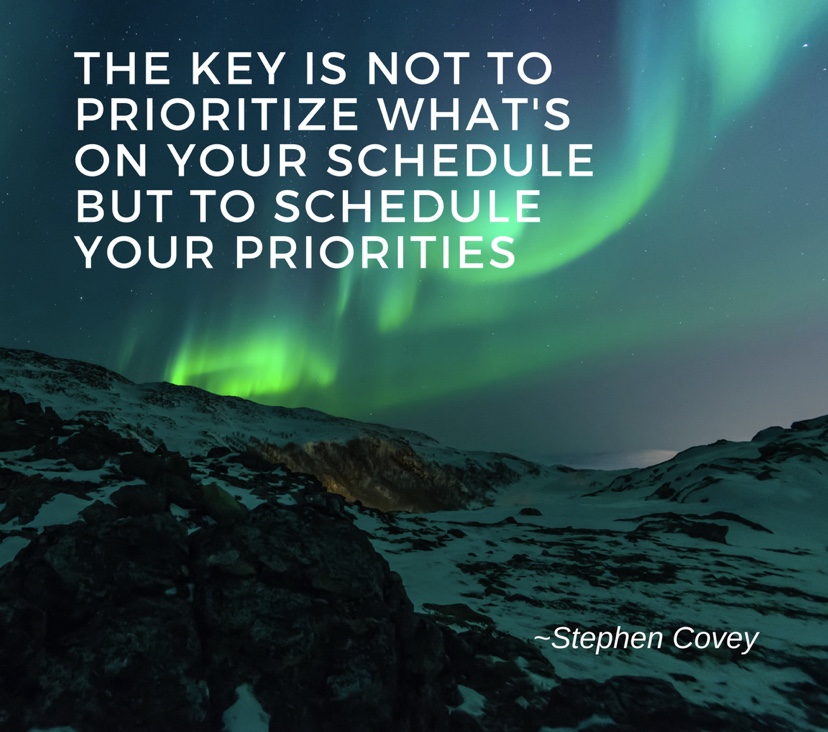
Schedule your priorities

If you prioritize your schedule, you are operating based on the picture right in front of you. This is important, but it can also be a trap. By only looking at a To Do list (one day at a time), deadlines can creep up and big goals can be missed. By prioritizing your schedule for the day, you’re basically in a reactive mode. You look at your schedule and say, “Ok. I need to do x, y, and z today to put out these fires or, at the very least, not let the fire spread.”

The more you can step back and look at the whole picture (instead of only at the part immediately in front of you), the quicker you’ll be able to reach your overarching goal. Retired Navy Seal Jocko Willink describes this as “detaching” from the situation by looking up and out.

If you are looking down the scope of a gun, you are less aware of your surroundings. Every once in a while you need to take your eyes off of that extremely narrow point of view so you can see what’s going on around you – you need to detach to see the whole picture. By doing this, you can reprioritize what is the most important thing you need to do to get you to where you want to go.

The further out you can look, the better you can plan. You can look at what you need to get done for the year, reverse engineer that to what should be done at the halfway point, what should be done by the end of the quarter, by the end of the month, end of the week, end of the day, and what you need to be doing right now to make sure you’re on track to completion.

If you only prioritize what is on your schedule for the day and don’t look ahead, you will feel like you’re doing a lot, but you’re not moving closer to achieving your big goals. Never confuse being busy with being productive. Schedule your priorities or your priorities will get tossed aside by life.